
Quick answer
Building corporate travel software from scratch means constructing a policy engine, approval workflows, global flight and hotel content, payments and reporting, which takes many months and a large ongoing engineering budget. Buying a white-label platform, like altovo's TravelDesk, gets a branded corporate booking portal live in weeks. Build only if you have a genuinely unique requirement and the engineering team to maintain it long term; otherwise buy.
Most travel management companies reach the same fork in the road. Corporate clients want a booking portal that enforces their policy, routes approvals, and reports on spend. You can build that yourself, or you can put your brand on a platform that already does it. This guide lays out both paths honestly: what building really involves, what it costs, when buying wins, and how to decide.
What is corporate travel software?
Corporate travel software is the system a business, or the TMC serving it, uses to book and manage employee travel. It is not just a booking tool. It has to encode how a company wants its people to travel and then hold everyone to it. The core pieces are:
- Policy enforcement, rules for cabin class, price caps, preferred suppliers and advance-purchase windows
- Multi-level approvals, so trips route to the right managers before they are booked
- A self-service traveller portal where employees search and book within policy
- Global flight and hotel content from GDS, NDC, low-cost carriers and hotel sources
- Real-time spend reporting for finance and travel managers
- Enterprise SSO so travellers sign in with their existing corporate identity
The case for building
Building your own corporate travel software is attractive for one honest reason: total control. You own the roadmap, the data model, and the exact way policy and approvals behave. If a corporate client has a workflow no off-the-shelf product supports, you can build precisely that. You also avoid depending on a third party for uptime and future direction.
Building genuinely makes sense when you have a requirement that is core to how you win business and that no platform can meet, and when you have an engineering team that can not only ship it but keep maintaining it for years. That last part is where most build decisions quietly fall apart.
The true cost of building
The build cost people picture is the first version. The real cost is everything after it. Corporate travel software is a moving target, and you own the whole thing once you write it.
- The policy and approval engine is deceptively deep. Rules interact, exceptions pile up, and every client wants a variation.
- Global content means integrating and maintaining connections to GDS, NDC and low-cost flight sources plus hotels, each with its own quirks and contracts.
- Payments, invoicing and compliance, including PCI-DSS, are ongoing obligations, not one-time features.
- Reporting has to stay accurate as data grows, and finance teams will ask for more views over time.
- Maintenance never stops: airline schema changes, security patches, new client requests and bug fixes all need a standing team.
Added up, building is many months to a first launch and a permanent engineering line on your budget. For most TMCs, that money and time is better spent selling and servicing corporate accounts.
The case for buying
Buying a white-label platform flips the equation. The policy engine, approvals, content, payments and reporting already exist and are already maintained. You configure them to your brand and your clients rather than writing them. You go live in weeks, your costs are predictable, and someone else absorbs the airline and security changes that never stop coming.
The trade-off is control. You work within the platform's model instead of inventing your own. For the large majority of TMCs, that is a good deal: the platform's model already covers policy enforcement, multi-level approvals, real-time spend reporting, enterprise SSO, global flight and hotel content and a self-service traveller portal, which is almost always what corporate clients actually need.
Build vs buy: how to decide
The decision comes down to whether your requirement is genuinely unique and whether you can carry the software long term. Here is the trade-off side by side.
Build
Own it end to end
- Full control of roadmap and data model
- Fits a truly unique workflow exactly
- Many months to a first launch
- Large upfront and ongoing engineering cost
- You maintain content, payments and compliance forever
- Best when the product is your competitive edge
Buy
Configure and launch
- Branded portal live in weeks, not months
- Predictable licence instead of a build budget
- Policy, approvals, content and reporting ready
- Provider absorbs airline and security changes
- You work within the platform's model
- Best when you want to sell, not maintain software
A simple test: if you cannot name a requirement that is both unique to you and impossible on any platform, buy. If you can, and you have the team to maintain it, building may be worth it.
How altovo's TravelDesk works
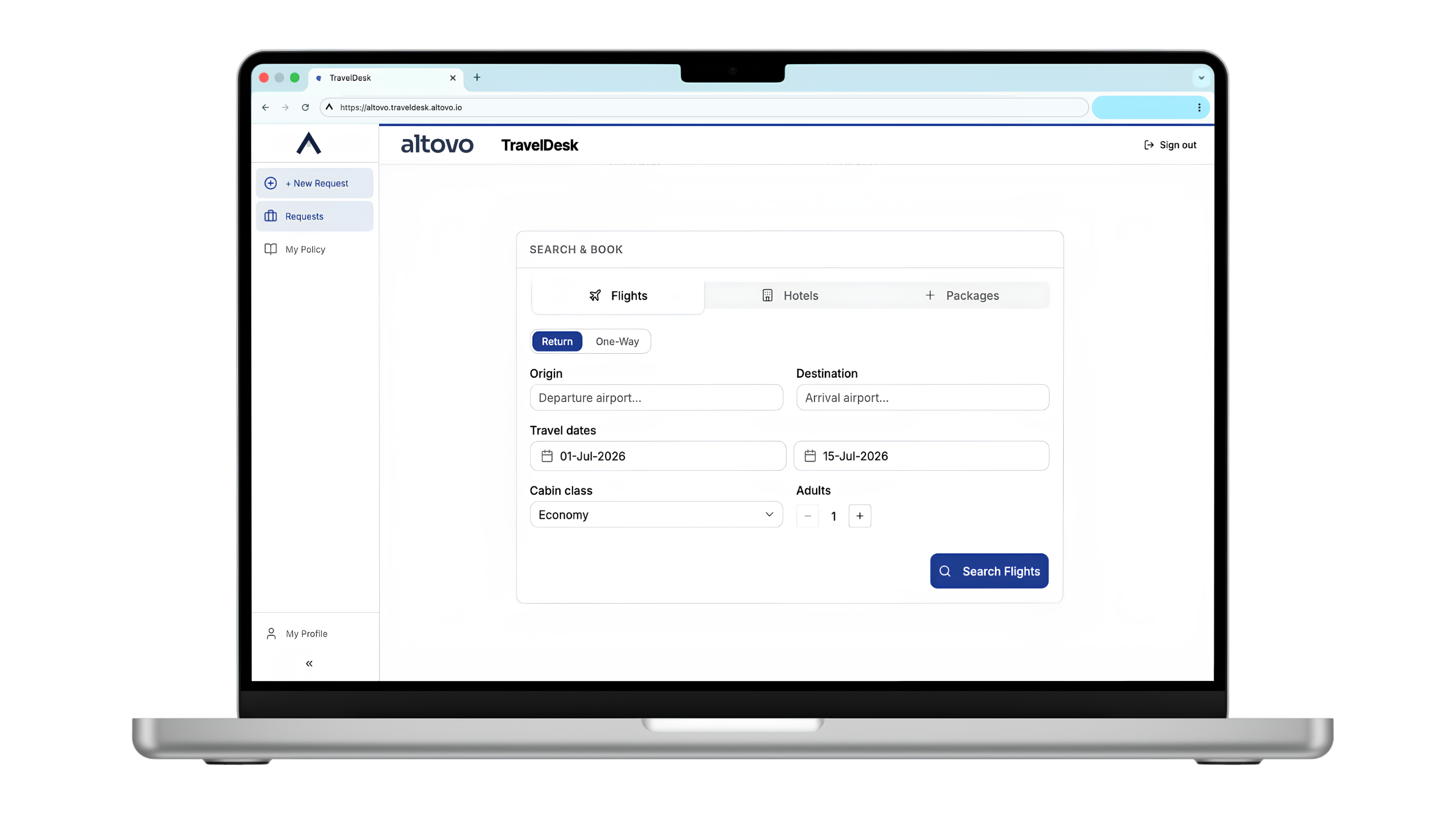
altovo (formerly easyGDS) offers TravelDesk, a white-label corporate travel product that gives your corporate clients a branded self-service portal with policy enforcement, multi-level approvals, real-time spend reporting and global flight and hotel content. You configure it once per client, and it goes live in weeks not months, so you skip the build entirely and keep your brand on the front. See how it fits corporate travel. The same build-vs-buy logic runs through our guide to starting an online travel agency, and you can see the full stack behind it on the platform.
Trusted by teams like




Frequently asked questions
How long does it take to build corporate travel software?
Building corporate travel software from scratch typically takes many months to well over a year, because you have to construct a policy engine, approval workflows, global flight and hotel content, payments and reporting, then test it all. Buying a white-label platform gets a branded portal live in weeks, because those parts already exist.
What features does corporate travel software need?
The core features are policy enforcement, multi-level approvals, a self-service traveller portal, global flight and hotel content, real-time spend reporting, and enterprise SSO. Payments, invoicing and duty-of-care tracking round out a complete corporate travel product.
Is it cheaper to build or buy corporate travel software?
For most TMCs it is cheaper to buy. Building carries a large upfront engineering cost plus ongoing maintenance, content deals and compliance work. Buying a white-label platform turns that into a predictable licence, and you go live far sooner.
What is a TMC?
A TMC, or travel management company, is an agency that manages business travel for corporate clients. It books flights, hotels and transfers, enforces travel policy, handles approvals and reporting, and supports travellers, usually through a dedicated corporate booking portal.
Launch TravelDesk with altovo
Talk to our team and see a branded corporate travel portal live in weeks.
Get started →